London Blockchain Institutional Tokenisation Summit convenes industry experts to unpack the practicalities of tokenisation and move the conversation beyond reasons for adoptions and asset issuance into the realm of operational and commercial mechanics – from pilot projects into scalable institutional infrastructure.
Tokenisation is no longer a curiosity of financial innovation, a risky offshoot emerging from blockchain technology that the market needs to be persuaded to explore. Depending on who you ask, the global tokenised real-world asset (RWA) market is valued at between $30 billion and $60 billion, with Citi Institute projecting it to reach $5.5 Trillion by 2030.
In other words, the train has already left the station. It’s now the job of industry, finance, banking and legal experts around the world to come together and make sure it arrives at its destination in the most efficient manner, with all luggage in good shape, and, ideally, with a few more high-profile passengers picked up along the way.
This was the goal of London Blockchain Summit’s ‘Institutional Tokenisation Summit,’ which took place 7th July at the London offices of international law firm DLA Piper.
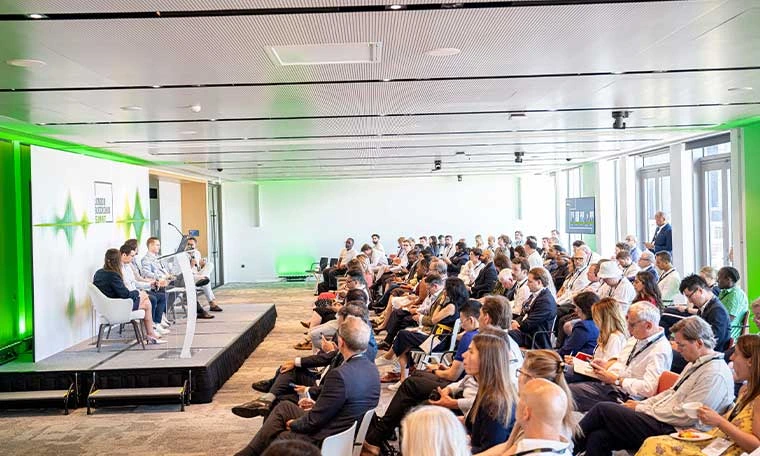
The event brought together 200 attendees from leading banks, asset managers, market makers, law firms, exchanges, and financial infrastructure providers — both TradFi and DeFi — with the aim of convening an institutional forum to progress the conversation on RWA tokenisation beyond the rhetorical exercise of ‘why,’ to the now more pressing practicalities of ‘where,’ ‘how’ and ‘who’.
Specifically, the summit set out to examine where tokenisation is already delivering measurable improvements in market access, settlement efficiency and asset control, and how existing questions around liquidity, ownership structures, legal frameworks and interoperability can be resolved.
When it comes to the who, the event provided an international lineup of speakers from the U.K., U.S., Switzerland and EU. The diverse range of finance and tokenisation experts included Juan Mendieta, Co-Founder at Keyrock; Bohumil Vosalik, Chief Executive & Investment Officer at 319 Capital; Myles Harrison, Chief Product Officer at AMINA Bank; Kevin Barr, Director of Digital Assets Product and Platform Strategy at Federated Hermes; Abrar Akhtar, Vice Chairman of The British Standards Institution; Brian McNulty, Geneal Partner Lingfeng Capital; and Theo Golden, Investment Manager and Tokenisation Lead at investment manager Baillie Gifford.
The day’s packed schedule of talks and panels — interspersed with plentiful coffee-fuelled networking breaks — was structured around three content pillars that covered the full tokenisation lifecycle.
The first portion of the day examined the legal, custody and settlement foundations required before a tokenised asset is fit for institutional use; the second addressed the infrastructure gap between what currently exists and what markets need before tokenised assets can be traded, financed and used as collateral; and the third delved into specific asset classes — including gold, commodities and equities — to shine a light on where the commercial case is already being made and the structural problems that digital infrastructure can, and already is, solving.
The keys to unlock institutional issuance
Starting with the first pillar, the intensive day of expert talks opened with a panel on ‘Building the Tokenised Issuance Stack,’ which discussed what is required to turn tokenised issuance from a pilot exercise into a scalable institutional model.
This was echoed by the panel’s moderator Paul Landless, Partner at DLA Piper, who suggested he’d seen “a lot of focus on interoperability” from clients of late.
Interoperability in tokenisation essentially means that tokenised assets can move, integrate, and function seamlessly across different platforms, blockchains, custodians, and financial systems using common standards.
Fellow speaker, Shrey Rastogi, CEO at blockchain-based decentralised infrastructure project KAIO, put the emphasis on this latter point, ‘standards’, another of the day’s key themes and one inextricably linked to interoperability.
He argued that to build a credible solution for onboarding, record-keeping, ownership control, cash settlement, and integration with existing market infrastructure, there has to be regulatory standards acceptable for traditional institutions.
Thus, to achieve wider institutional use of tokenised assets, interoperability and standards are essential because they enable efficient settlement, broad market access, regulatory compliance, reduced operational risk, and compatibility with existing financial infrastructure.
Tokenised funds
These discussions led smoothly into the next panel on ‘Tokenised Funds’ and how they can move beyond superficial wrappers to sit credibly within an authorised fund structure, without simply creating a cosmetic digital twin.
Amongst the speakers was Theo Golden, Head of Digital Assets at investment manager Baillie Gifford, who recently launched the first public fully native U.K. tokenised fund, the Baillie Gifford Enhanced Yield Fund (BAGEY).
Announced on June 22, the USD-denominated BAGEY allows eligible investors to access, for the first time, an actively managed, short-duration portfolio of public corporate bonds through a U.K.-regulated Open-Ended Investment Company (OEIC) structure on Ethereum and Solana. In essence, it provided market participants with the opportunity to invest in short-dated bonds via blockchain-based tokens, or as Golden described it, “we are an example of moving from a wrapped to an operating model.”
Needless to say, he also had some notable hands-on experience to offer the assembled dignitaries from DeFi and TradFi, and it was his view that regulatory clarity and compliance is crucial.
“Just because a fund is tokenised doesn’t mean you lose your regulatory responsibilities,” said Golden.
This was a view shared by many of the day’s speakers, who saw a clear throughline from regulatory clarity to standards to interoperability.
TMMF in the USA
The final panel of pillar one focused on Tokenised Money Market Funds (TMMFs) in the U.S. Specifically, assessing the legal foundations for collateral mobility and exploring what scaling requires in practice, from operational risk frameworks to settlement optionality.
Based on the discussion, one requirement for scaling appears to be ‘trust’, between fellow market participants and from the regulators.
Henry A. Stiles, Chief U.S. Counsel for digital assets at leading asset management firm Franklin Templeton, pointed to the success of his firm’s TMMF, ‘Benji’ – a blockchain-integrated recordkeeping system that enables the tokenisation and servicing of mutual funds on public blockchain infrastructure.
According to Stiles, the U.S. Securities and Exchange Commission (SEC) was so impressed with Benji’s blockchain record, that they allowed the fund to go fully on chain, without a mirrored traditional record off chain.
Demonstrating that if the technology works and you provide transparency and compliance, then regulators are willing to trust and adapt.
The embracing of products such as Franklin Templeton’s Benji TMMF by regulators is the kind of case study that inspired fellow speaker Kevin Barr, Director of Digital Assets Product and Platform Strategy at investment manager Federated Hermes, to make the bold claim that “blockchain may be this generation’s financial market infrastructure.”
However, there is still much work to be to realise this, with Barr suggesting that the tokenisation of the entire market is necessary, including the underlying assets.
“Challenges exist because we’re running parallel markets,” he argued.
Confidentiality and compliance
Another barrier to institutional adoption was explored in a talk titled ‘Confidential Assets and the Next Phase of Institutional Tokenisation,’ presented by Martin Halford, Interim Chief Executive Officer & Chief Technology Officer of fintech company Polymath Network.
Halford began by asking who in the audience would be comfortable for their trades to become visible on the internet for everyone to see — a largely rhetorical exercise, as the answer almost anywhere would be “no,” which was immediately demonstrated by the sea of unraised arms that greeted the question.
According to Halford, full market visibility of balances, trades and counterparties creates a structural barrier for institutional adoption of tokenised assets. This, in turn, creates the need for a confidentiality system that can work within regulated financial markets, while still providing compliance and market integrity.
“On the blockchain there’s nowhere to hide, by design, but regulated markets rely on confidentiality,” argued Halford. “You need positions to be protected, regulators to see everything they need to, and for both to happen at the same time. This is hard to do on blockchain.”
In heavily regulated traditional financial markets regulators often require detailed information about those transacting, trading and issuing, but this information is not made public. In the blockchain space, this dynamic is reversed, with information on transactions public on decentralised, distributed ledgers, but pseudoanonymity providing a level of confidentiality and privacy and platforms often not requiring detailed information about transactors.
Herein lies the dilemma, how to marry the compliance requirements of traditional finance and the confidentiality institutional participants require, with the seemingly diametrically opposed blockchain technology.
For Polymath, the answer is to “reveal everything, reveal nothing,” through zero knowledge proofs (ZKPs), a cryptographic method used to prove knowledge about a piece of data without revealing the data itself. This is why they launched Polymesh, a blockchain that requires those who transact on it to “give up their identity,” which will not be made public on the blockchain but can be used to bridge the gap between blockchain and regulators by confirming the necessary information to the latter via ZKPs.
This system shares similarities with the Canton Network, a public blockchain network developed for financial institutions to enable secure, interoperable, and privacy‑preserving transactions, which describes itself as: “The first privacy-enabled open blockchain network, ensuring limitless connections that preserve privacy.”
Conveniently, James Pollock, EMEA Sales Lead, Digital Asset for the Canton Network, was one of the speakers on the day’s very next panel – an equally vital discussion on how to realise cross border collateral mobility.
Interoperability needed for mobility
With the barriers to institutional use laid bare in pillar one, after a brief networking break the second section of the summit took over the narrative. It focused on what one does with these tokens, once created, and the ‘infrastructure gap’ between what exists today and what markets need before tokenised assets can be traded, financed and used as collateral at scale.
Sophie Lessar, Partner at DLA Piper, moderated the panel, titled ‘Realising Cross Border Collateral Mobility,’ whose diverse group of speakers, included Pollock from Canton Network, Ruchir Dalmia, European Director (Stable coins & Payments) at Polygon Labs, and Peter Bidewell, VP of Institutional Product Adoption at Parfin.
The discussion set out to unpack how tokenised collateral and regulated cash legs can be co-ordinated across institutions and jurisdictions, as well as addressing further blocks to adoption at scale.
“A lot of discussion around tokenisation has focused on the assets themselves, these questions are still important, but the focus is shifting to a more fundamental question: what operational outcomes are we trying to achieve? To mobilise collateral more efficiently cross-border,” said Lessar, in her introduction.
She returned to the issue of interoperability, saying: “A lot of what they’re seeing from a legal point of view, is how the TradFi world and blockchain world need to be interoperable so you don’t create two universes or cut one of them off.”
This was backed up by Pollock, who said that, from the perspective of the Canton Network, “interoperability is about finding solutions that are better than Business As Usual.” He added that “what we’re finding is that it’s about connecting counterparties to bring real world utility and value.”
This latter point nicely summed up one of the driving forces behind the tokenisation summit, not just getting decision makers and experts into a room to discuss how to solve the issues facing the space, but to build the necessary connections between these individuals and entities that can unlock the solutions – cue another well-timed networking break.
Digital gold
The day’s third and final pillar followed an impressive lunch spread, enjoyed on DLA Piper’s balcony with views of St Paul’s Cathedral and the London Eye – a skyline that marries the new and the old, the traditional and the innovative, and which provided an appropriate backdrop to an exploration of how and why to put traditional asset classes, such as gold, commodities and equities, on digital infrastructure, and where the commercial case is already being built.
Abrar Akhtar, Vice Chairman of the DLT/ 1 – Technical Committee at the British Standards Institution (BSI), kicked off this pillar by giving a talk in which he called for experts — many of whom in attendance — to help shape institutional standards for financial asset tokenisation.
He then joined Mike Oswin, Global Head of Market Structure and Innovation at the World Gold Council, and Raj Roy, CEO of blockchain firm Analytiq Global, for a discussion of digital gold.
As noted by one the panellists, tokenisation is more prevalent in the real estate market than gold, with currently only two gold tokens in the market in which any retail investor can invest, PAX gold (paxos) and Tether Gold (XAUT).
According to Roy many more are in development but they are being held back by a lack of clear regulation, particularly in the U.K., which is still awaiting its digital asset regime — expected to come into force October 2027.
Meanwhile, for Oswin, what is holding the tokenised gold market back is a lack of clarity and assurance over how the physical asset is managed.
“Getting trust in the physical layer is crucial,” he suggested. “When buying a tokenised asset such as gold on a decentralised blockchain, you need to be able to trust someone somewhere that the gold is actually there.”
This discussion clearly hit a chord with the industry crowd, many of whom lined up to continue the conversation with the panellists well into the coffee break that followed. This also indicated that many in attendance apparently agreed with Roy, who said gold has the potential to rival real estate for the tokenisation crown.
Who can take advantage of booming tokenised equities?
After another panel titled ‘Tokenised Commodities Beyond Gold,’ the day’s schedule rounded off with a talk on ‘Tokenised Equities’ from Richard Johnson, CEO & Founder of securities trading firm Texture Capital Holdings.
This June, tokenised on-chain equity volumes surged 145% to reach $3.86 billion, in the wake of the SpaceX IPO. In his talk, Johnson elaborated on some of the reasons behind this rapid growth, from new distribution models and broader investor access to faster transfer and more flexible ownership structures. He also identified the operational, technical and market-structure steps needed for liquidity to further scale.
From his U.S. perspective, Johnson said that the tokenised equities space has been moving much faster since the re-election of President Donald Trump last January, and the subsequent changing of the guard at the SEC – with former chairman Gary Gensler’s hardline approach to digital assets replaced by a much more conciliatory one from Trump’s pick for new chairman, Paul Atkins.
Johnson went on to suggest that the post-Trump blockchain push in the U.S. has left many countries, not least the U.K., scrambling to keep pace. However, he commended the progress being made by the U.K. Financial Conduct Authority (FCA), who recently set out its shared vision — with the Bank of England — for tokenisation in U.K. wholesale markets.
He also noted an area where the U.K. has a competitive advantage, namely its digital securities sandbox (DSS), a framework established in 2024 for participant firms to experiment with different ideas and technologies, and actually bring them to market — something the U.S. doesn’t have.
Looking ahead, Johnson concluded by saying that: “I think everything is going to go on chain at some point,” adding that “it’s a better technology and solves a lot of problems with capital markets.”
However, if this optimistic prediction is to come to pass, Johnson told the assembled bankers, regulators, legal and finance experts that “now is the time to participate” — a message that succinctly encapsulated the rationale behind the tokenisation summit.
This was not an event focused on the relative merits of tokenisation — although naturally many of these came up throughout the day’s enthusiastic conversations. Rather, it was working from the assumption — or fact — that this debate has already been won by the advocates, that tokenisation is already here. The summit intended to move the conversation forward from this starting point, focusing on exploring practicalities and making the connections that could allow the burgeoning space to succeed and scale.
Judging by the impressive array of market participants in attendance, from traditional finance, banking, and payments to fintech, law and regulation, if nothing else it appears to have moved this needle forward.
Blockchain events
The team behind the tokenisation summit, Bopper Events, forms part of the broader London Blockchain event ecosystem, which was established to showcase how blockchain technology is moving beyond theory and into real-world enterprise and government applications.
Bopper Events, part of marketing firm Bopper Media, focuses on creating content-led industry events that turn complex technology conversations into clear, commercially relevant experiences. Its portfolio spans conferences, summits, webinars and networking forums designed to connect business leaders, innovators, policymakers and investors across frontier technology and industry transformation.
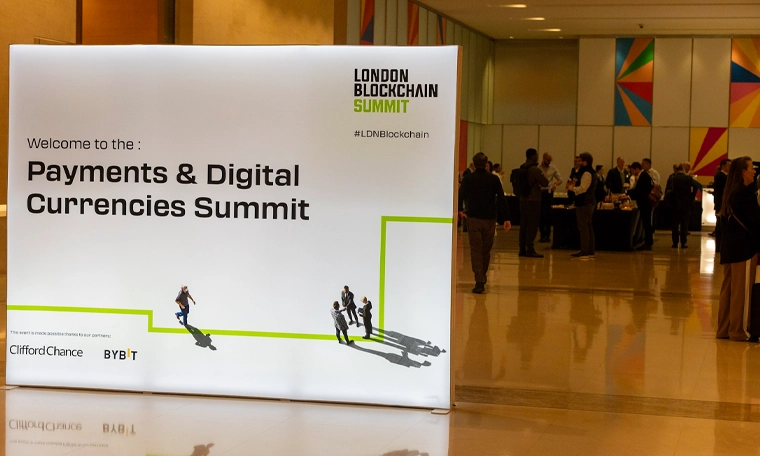
Alongside its flagship London Blockchain Conference, previous Bopper events included an exclusive Summit titled ‘More than just AI: The Role of Emerging Technology in Public Service Reform,’ hosted by the U.K. House of Lords in the Palace of Westminster last spring, which explored how emerging technologies can drive public sector reform; and, more recently, the second Finance Summit: Payments & Digital Currencies, which took place 12th March at the offices of Clifford Chance in London’s Canary Wharf finance district and brought together entrepreneurs, lawyers, and regulators to discuss how broader blockchain adoption can be achieved.
Those who want to take part in shaping further conversations around blockchain, DeFi, AI and fintech at future events can register their interest on the London Blockchain website.