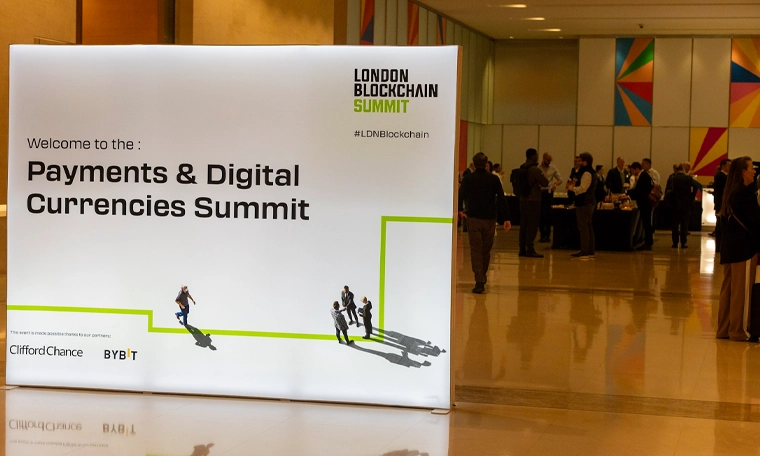
Interoperability and “making the business case” were the catchphrases of London Blockchain’s Payments & Digital Currencies Summit last week, where a smorgasbord of leading bankers, legal experts and entrepreneurs gathered in London to discuss how to achieve scalability and greater adoption for blockchain technology.
Stablecoins, central bank digital currency (CBDC), and tokenised deposits, were on the agenda at the 12 March summit, in which a packed schedule of talks and panels shed light on the barriers to adoptions, as well numerous cases where blockchain is already transforming payments, treasury, and real-time settlements.
The location for this discussion was the offices of international law firm Clifford Chance, appropriately nestled in the heart of London’s Canary Wharf finance district, where the winds of change were blowing strong last Thursday, both figurately and literally — attendees from around the world being treated to some vintage U.K. weather on arrival.
The summit, the second such event held at Clifford Chance, was a more ‘focused, high-impact’ event to the broader-in-scope London Blockchain Conference, the most recent edition of which took place last October and covered all things blockchain.
By contrast, last Thursday’s summit narrowed its scope to how blockchain can move from concept to real-world enterprise and government implementation. Based on the way the day’s ten expert-led panels and keynote speeches played out, it appears there is already a consensus amongst those in the know, both in and outside of the industry, that in order for blockchain to shape the future of finance two things in particular are needed: interoperability and making the business case.
Interoperability amongst blockchains, wallets, institutions, and regulatory regimes is necessary to remove friction and fragmentation, allowing for blockchain adoption to scale; at the same time, to convince the elite of traditional finance to spend the money necessary to make this a reality, innovators, early adopters and advocates must make a persuasive business case for the technology.
Setting the tone
The summit kicked off with an introduction by London Blockchain director Alex Stein, who set the tone by describing 2025 as the year of stablecoin hype, and predicting 2026 will be the year of deployment and adoption.
In a similar vein, he also banned the phrase “underlying technology” – a joke of course, but one which spoke to the prevailing sentiment amongst the summit’s speakers and attendees that blockchain needs to move beyond discussions and debates focused on “which token” and “how the technology works,” towards a more persuasive and meaningful conversation about “what the technology can do.”
This point was returned to over and again throughout the day as speakers and panellists advocated for making the business case, a common refrain being that those who want to see broader blockchain adoption must make it simpler for the user by “articulating user experience” rather than focusing on the technology, which many consumers simply don’t understand – and may never.
Stein was followed onto the stage by opening keynote Peter Left, Head of Digital Assets and Market Innovation at Lloyds Banking Group, whose day job is seeing how and where digital ledger technology (DLT) can improve customer experience.
He got the energy up in the packed Clifford Chance lecture hall by asking the besuited attendees to stand if they want more control over their payments, would like real-time transparency, and would like to mobilise more of their assets as liquidity without paperwork, delays or operational gymnastics.
Naturally, the room swiftly took on the appearance of a step aerobics class, as the assembled lawyers, enterprise leaders and executives bobbed up and down in affirmation.
Beyond warming up the crowd on a cold spring morning in London, the point of this exercise was that these questions represent the real outcomes that become possible “when we upgrade money,” moving the blockchain debate beyond theory and pilots to production at scale.
With the tone set, the rest of the day’s panels and talks took to the task of identifying and addressing the roadblocks to achieving this goal.
The need for interoperability
The number one hurdle to greater institutional and consumer blockchain adoption, according to many of the summit’s speakers, is interoperability — or rather the lack thereof — between the assets, the institutions that transact in them, and the governing regulation.
In essence, if blockchain technology — whether stablecoin, tokenised deposit or CBDC — is to realise its potential, the fragmentation plaguing the space must be overcome.
This was made clear in the first panel of the morning, which saw speakers from Deutsche Bank, Rayls, Teranode Group and ByBit discuss how banks and corporates compare live deployments of tokenised deposits and regulated stablecoins.
The representative from digital asset exchange ByBit argued that one of blockchain’s biggest strengths, innovation, might ironically also be a major barrier to its adoption. For example, if “every Monday there’s a new blockchain,” how can consumers and corporates trust that any one token or digital asset will ever have the utility of traditional assets.
This point was repeated in a later panel on ‘Corporate Finance Use Cases,’ in which another equally diverse group of speakers from TradFi and DeFi agreed that “we can’t operate on thousands of different blockchains, we need to be thinking about interoperability.”
In real terms, this doesn’t necessarily mean the whole finance world deciding on one favoured blockchain, but it does mean building and improving interoperability between chains, issuers, wallet providers and custodians. Only then can a digital asset be trusted as a reliable and useful payment method.
But the problems of interoperability don’t begin and end with the assets and crypto companies themselves, an equally pressing problem comes from the regulation governing the space, which marked another major talking point of the summit.
One speaker confidently proclaimed that “regulation is the main driver for blockchain adoption,” which is why interoperability between different frameworks around the world is crucial.
The problem of fragmented regulatory approaches is not new or unique to the blockchain sector, but the comparatively nascent industry continues to suffer from a lack consensus amongst regulators and legislators on how best to account for the technology. This in turn has resulted in the pace and nature of regulation varying wildly around the globe.
As one frustrated speaker noted, “public blockchains don’t understand borders and a lot of friction is created by having to contend with different regulation in different jurisdictions.”
However, there are signs of positive progress and increased institutional attention to solving the problem of fragmented regulation and a lack of interoperability, which one speaker from Deutsche Bank described as an evolution, rather than a quagmire.
They went on to highlight the Bank of International Settlement’s (BIS’s) Project Agorá, which is currently exploring a new way to process wholesale cross-border payments using tokenisation and other cutting-edge technologies such as smart contracts. The project’s goal is to design a system that is faster, more transparent, and more accessible than the current model, and building it within existing regulatory parameters.
Deutsche Bank is part of Project Agorá, and their representative argued that this kind of collaboration between institutions is what interoperability means, ensuring that abstract concepts such as legality are standard and technologically neutral.
While there appears a strong consensus on the need for interoperability, there remains the challenge of how to convince businesses and institutions to front the costs of achieving it, even though the rewards may be a few years down the line yet. On this, the summit also provided some answers.
Making the business case
In an afternoon panel exploring ‘Institutional DeFi that matters’ and starring representatives from Tokenovate, Agant and Hashdex — a blockchain financial market infrastructures firm, a stable issuer, and a crypto asset manager, respectively — the question was posed “what’s holding people and institutions back from greater blockchain adoption?”
The answer, in short, was “making the business case.”
Echoing similar sentiments voiced throughout the day by a broad range of speakers, the panel of blockchain players agreed that the industry needs to get to a point where it is “making compelling arguments about why financial institutions should spend money adopting this technology, when it may be a few years until the benefit becomes clear.”
In this regard, one of the core selling points of blockchain technology is its potential to free up access to collateral in TradFi.
Tokenising assets, which enables real-time settlement and tracking on shared ledgers, can reduce delays, intermediaries, and operational buffers, allowing institutions to move, reuse, or reallocate collateral faster, or even instantly, negating the need to keep large amounts locked up as precautionary reserves.
This potentially game-changing saving in time, money and resources represents perhaps the strongest argument DeFi could make to the stalwarts of TradFi. A point explored in more depth in an afternoon panel titled ‘Unlocking Mobile Collateral,’ which saw representatives from NatWest and Fidelity International discuss how blockchain could provide faster trades, meaning “not tying up capital.”
The speaker from NatWest was keen to note how this benefit is no longer purely hypothetical, with the European Central Bank (ECB) already exploring the settlement of wholesale financial transactions recorded on DLT platforms in CBDC.
In a similar vein, a speaker from the London Stock Exchange Group (LSEG), with experience in Latin America, told attendees of another panel that, while much of the world is still discussing the application and utility of blockchain, the technology is already being widely adopted in LatAm by consumers, business and public sector bodies.
Such examples demonstrate that the business case for blockchain is already being made by major organisations and governments around the globe.
Optimism to close
The London Blockchain Finance summit’s closing keynote continued this message of optimism and real-world progress, whilst also bringing the conversation full circle back to the event’s ultimate goal: greater adoption.
David Palmer, COO of Pair Point — an innovative Economy of Things (EoT) global platform owned by Vodafone and Sumitomo Corporation — rounded off the summit by emphasising the importance of global wallet architecture, including on-chain wallets, external accounts, and embedded finance.
In this regard, he highlighted work already underway at Vodafone on linking sim cards to blockchains, AI and digital finance.
Palmer concluded his keynote by asking the still energetic crowd the rhetorical question “how do you get assets into tokens at scale?” To which he answered: regulatory clarity, interoperability and business case proof — again underscoring many of the day’s key talking points
As the buzzing attendees filed out of the Clifford Chance theatre, eager to get on with the equally important task of networking over wine and canapes, there was real optimism for the future of blockchain and finance, despite the noted hurdles.
In part this optimism came from the simple fact that so many top business leaders, legal minds, innovators and entrepreneurs were in attendance and clearly committed to the project of making the technology a success.
This is part of the mission of London Blockchain Conference ecosystem, which brings together these industry leaders to address practical implementation challenges, as well as providing a hub for individuals, businesses and institutions seeking real-world blockchain innovation.
For any interested parties wanting to be a part of this conversation going forward, don’t miss the next London Blockchain Finance summit, ‘Real World Asset Tokenisation’, on July 7 in London.