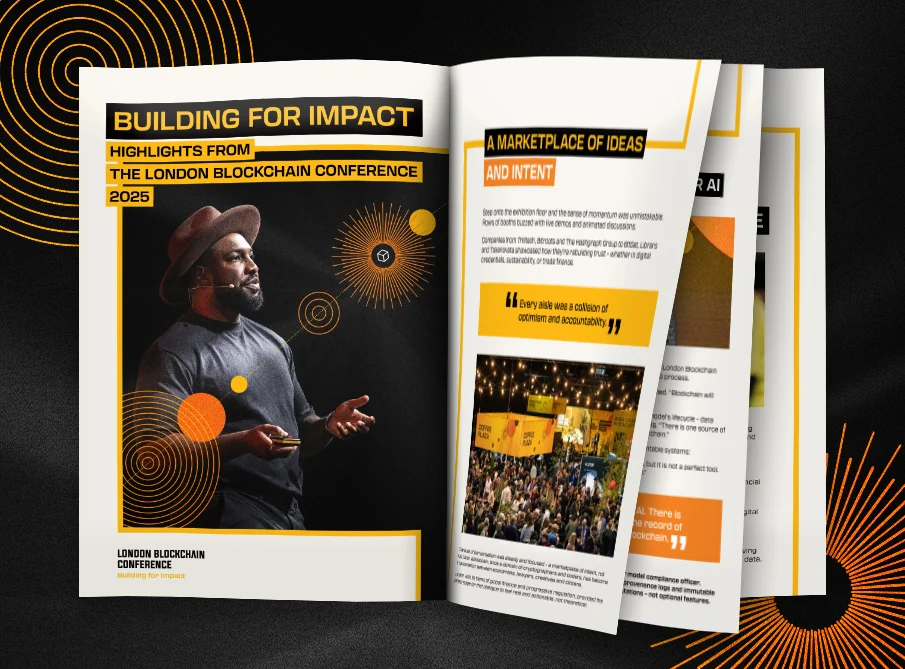
Key Insights:
- Blockchain is shifting from hype to real-world, large-scale business adoption.
- Enterprises now focus on integrating blockchain into core systems, not debating its viability.
- Regulation and scalable infrastructure are accelerating global adoption.
- London Blockchain Conference 2025 spotlighted practical, proven blockchain use cases.
- UNDP highlighted global innovation gaps and the need for unified international collaboration.
- Misconceptions about blockchain’s capabilities still slow adoption in many regions.
- Governments and blockchain companies must co-create solutions to build trust and drive uptake.
- Emerging tech succeeds when it’s intuitive, useful and invisible to the end user.
- Blockchain + AI is becoming a powerhouse combo for next-generation applications.
- Misinformation challenges make AI adoption tricky, yet investment in AI continues to soar.
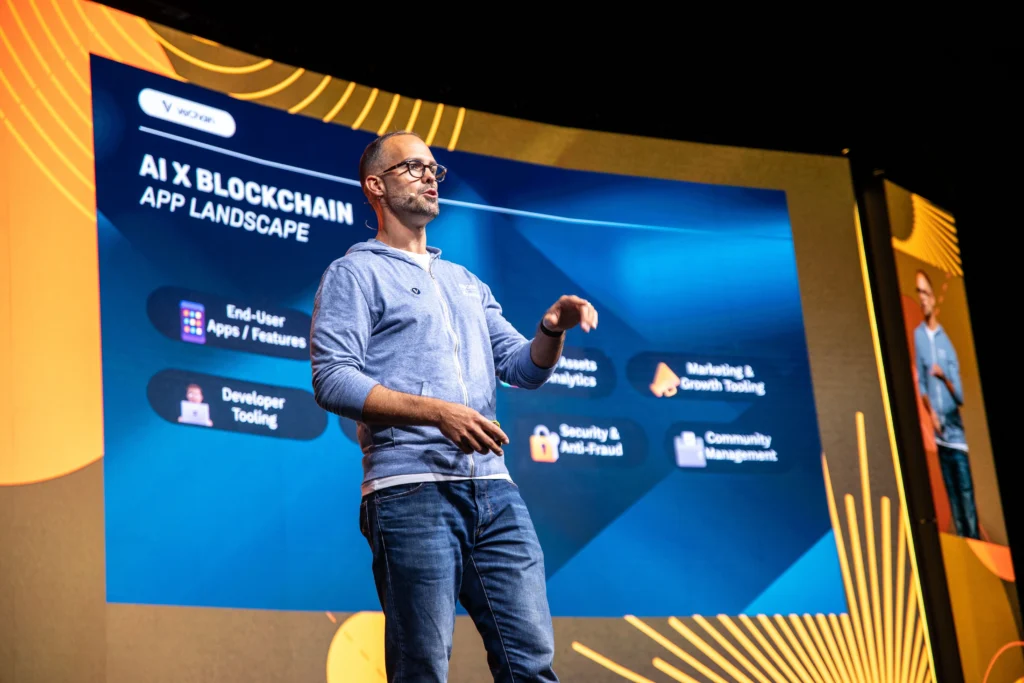
- Eight key domains show where blockchain–AI synergy delivers real value (apps, agents, analytics, security, etc.).
- VeChain’s VeBetter demonstrates practical integration of blockchain, AI and Web3 to incentivise positive actions.
- Innovation should prioritise solving real-world problems, not chasing flashy tech trends.
- Businesses now treat blockchain as essential infrastructure powering trust, efficiency and data integrity.
Blockchain has long been seen as a technology with immense potential but held back by hype around cryptocurrencies and projects that never seem to finish. In 2025, this narrative is shifting as the world moves beyond small-scale pilots and into genuine, large-scale business adoption.
Blockchain’s primary focus is no longer about whether decentralised ledgers actually operate seamlessly – as this has been proven to work – but how they can fit smoothly into the core systems of global business. Faster scaling methods and clearer regulations are now helping push this integration forward.
This shift in infrastructure is now creating real, everyday improvements – from tracking supply chains and managing digital identities to turning real-world assets (RWAs) into digital tokens. Many successful companies now use blockchain technology as a quiet but essential tool for trusted, verifiable information. This significant change was the focus of the London Blockchain Conference 2025, where industry leaders, investors and enthusiasts gathered to share emerging developments and practical insights.
Mind the Gap: Fixing the Future of Innovation
Despite the rising interest, the full potential of blockchain technology does not lie solely in the hands of companies building it. True progress depends on meaningful global collaboration. Currently, many regions and industries still face gaps in innovation and fragmented understanding of how the technology can be applied, slowing wider blockchain adoption.
Ana Grijalva, Co-ordinator of Blockchain Solutions for Digital Payments at the United Nations Development Programme’s (UNDP) Alternative Finance Lab, addressed this challenge on the Innovation Stage during Day 2 of the conference. She emphasised that aligned efforts between international organisations, diverse sectors and forward-thinking companies are critical for advancing blockchain on a global scale.
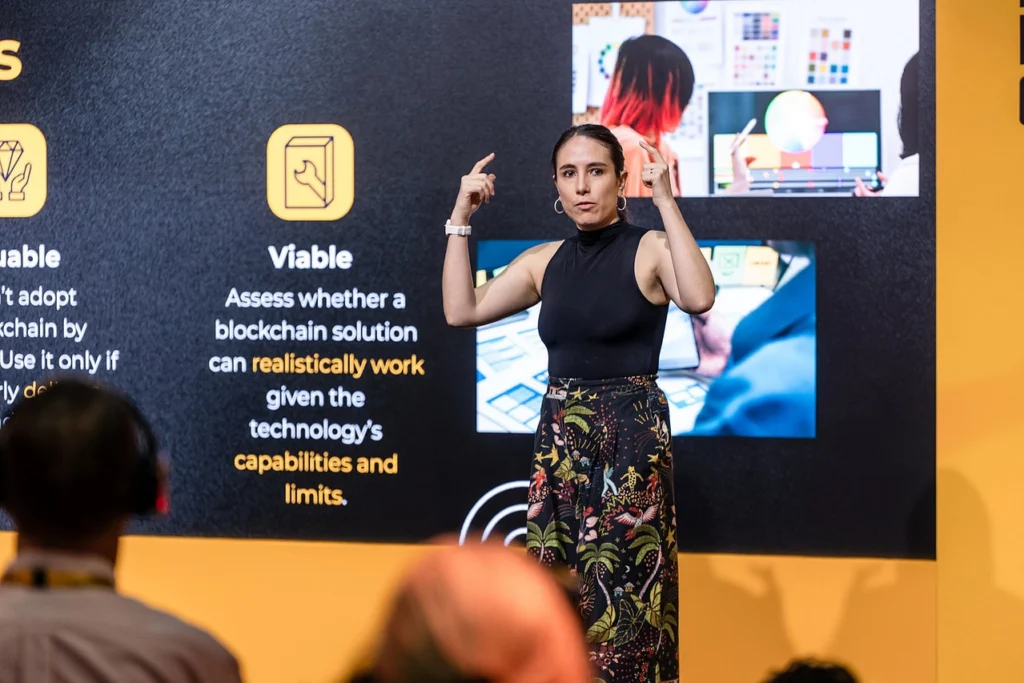
Grijalva said that even with growing interest, many institutions and leaders still misunderstand what blockchain can actually do. As she explained, some expect that transparency alone will attract investors, or that selling digital tokens will provide communities with a quick income. These ideas may sound good, but they’re not how blockchain technology really works. Closing these knowledge gaps is crucial if the world is to achieve global collaboration that leads to meaningful, practical progress.
“So, what I want to flag here for both sides, blockchain companies as well as the government, is that most of the time the conversation is not only around the technology,” she noted, highlighting assumptions on both sides that must be addressed to foster innovation within communities.
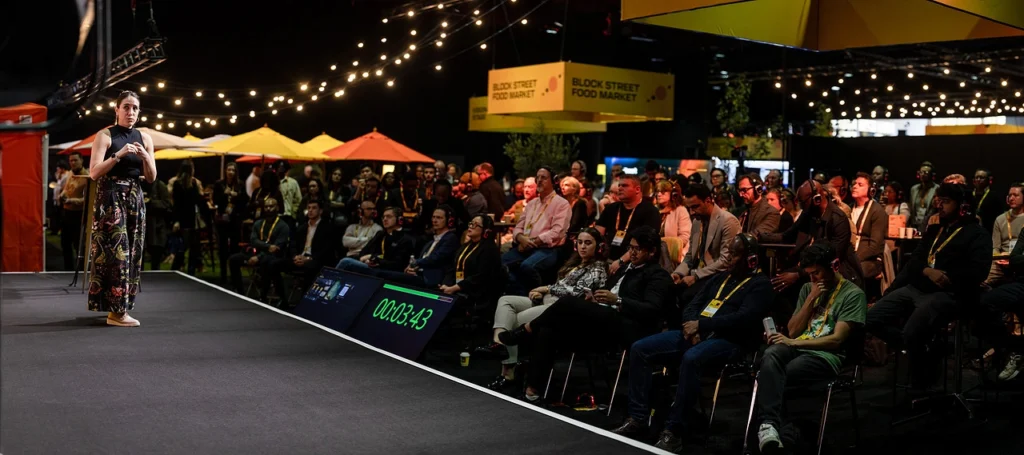
She advised blockchain businesses to work directly with governments – allowing them to experience the technology first-hand and involving them in developing new applications and services. While governments often focus on regulation, Grijalva stressed that they also play a crucial role in building trust amongst investors and potential clients. Once governments and businesses align their efforts, the path towards wider adoption becomes clearer and more achievable.
Breaking Tech Barriers for the Masses
In the case of blockchain and artificial intelligence (AI), this collaboration sets the foundation for building tools that do not just showcase technical promise but genuinely improve how people live and work.
In his keynote, Anthony Day, Marketing Director at VeChain, emphasised the need for companies to focus on creating technology that feels practical, intuitive and seamlessly woven into everyday routines to allow the public to trust, understand and ultimately embrace emerging technologies.
“Important differentiation; important distinction – blockchain in isolation as a technology as infrastructure as a domain is really hard to contexualised, because for the most part, what blockchains give you are building blocks that sit underneath the applications,” said Day.
“Ultimately, we’re not trying to maximise blockchain; we’re trying to maximise the appropriate use of blockchain technology in places where it fits,” emphasised Day, adding that in the eyes of the general public, what matters most is whether applications running on-chain or operated by these emerging technologies will be useful for them.
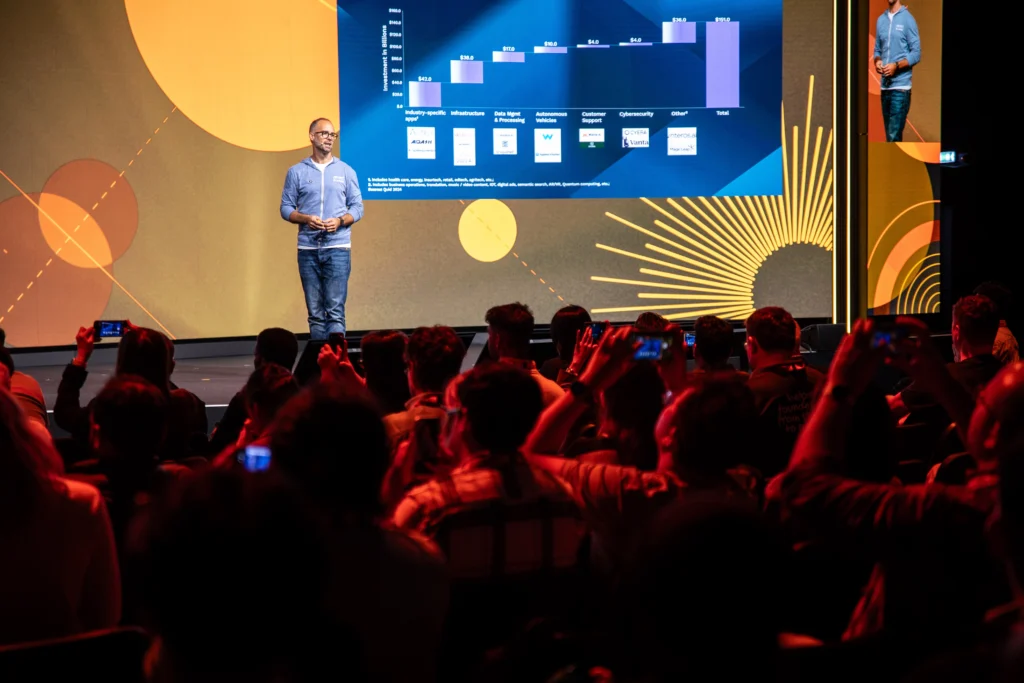
Today’s most forward-looking applications are no longer built on single technologies, he pointed out, noting that they thrive on the synergy between them, with blockchain and AI emerging as one of the most powerful pairings. This unity doesn’t just enhance performance but reshapes how digital services operate, setting a new standard for reliability and intelligence in the tools that people use daily.
Yet, in an era marked by rampant misinformation and the rise of deepfakes, AI has increasingly gained a negative reputation. What’s even more alarming is that this technology is becoming more intelligent through time. Amid fears of AI taking over jobs and fuelling further misinformation, Day said that we cannot deny that this technology is an epitome of utility, and this is very much apparent in the over $150 billion investment in AI applications generated in 2024.
For builders and developers, Day listed eight domains where the synergy of blockchain technology and AI can be used effectively in creating applications that have real value:
- End-user apps/features
- Autonomous Agents
- Data assets and analytics
- Marketing and growth tooling
- Developer tooling
- End-user support
- Security and anti-fraud
- Community management
For VeChain, the collaboration of not just blockchain and AI, but other Web3 technologies, is presented in their VeBetter product, a platform that rewards users for their sustainable actions, which can be a model for builders looking to integrate emerging tech into their services.
“It’s not how big it is; it’s what you do with it,” Day said, reminding builders that meaningful innovation is not measured by the sheer scale of a system but by the value it delivers. He also noted that there is a whole spectrum of things that they can incentivise, with blockchain and AI at the helm.
At the end of the day, it all comes down to how useful the applications are, Day said, but was quick to point out that there are a number of frontiers that need to be improved and worked on.
AI + Blockchain: Power with Purpose
Concluding his talk, Day reminded builders and companies that despite the progress of innovation, there remains a tonne of problems that have yet to be solved.
In this digital era, innovators should focus on real problems people face, including how people would be able to keep up with technology, not just on what looks exciting or new. Day’s keynote serves as a reminder that true progress comes from choosing work that helps communities in practical ways, even when those problems are less flashy or harder to solve.
Businesses are no longer treating blockchain as an experiment; they’re deploying it to solve real bottlenecks. From speeding up payments to proving data integrity and cutting out slow, costly middlemen, blockchain, with the help of AI, is becoming a quiet engine of trust across industries.